- News
- News Desk
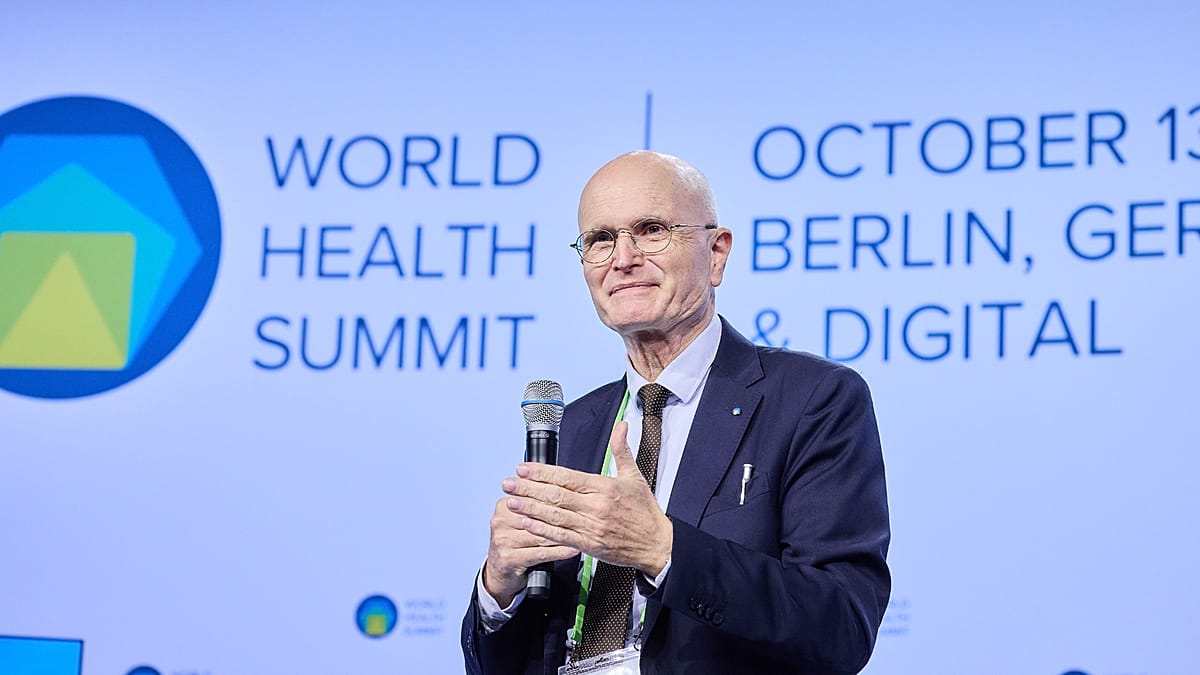
By Franziska Müller Published on 14/10/2026 - 6:15 GMT+2 Share Comments Add Euronews on Google Share Facebook Twitter Flipboard Send Reddit Linkedin Messenger Telegram VK Bluesky Threads Whatsapp In a world of multiple crises, global health must once again be seen as a team sport, says World Health Summit president Prof Dr Axel R. Pries in an interview with Euronews. He also sees Europe, built on the EU framework, in a leading role. In recent years the threats have increased, crises have multiplied. Health policy now has to rely on multilateral cooperation, explained Professor Dr Pries at the World Health Summit in Berlin. Global health, he said, is a team sport. ADVERTISEMENT ADVERTISEMENT For six years, Prof Dr Axel R. Pries has been president of the World Health Summit (WHS) in Berlin. The physician and physiologist previously served as dean and board member of Charité. In this interview with Euronews, Pries outlines one way to strengthen the resilience of the health system at international level. At the World Health Summit Regional Meeting 2026 in Nairobi in April, you said: "We don't have the virus, but we have a political virus." What exactly did you mean by that? Prof Dr Axel R. Pries : We are dealing with a global situation in which many countries are looking at health increasingly from a very national, sometimes even nationalist perspective. And I call it a virus because it is spreading across the whole world. It is a pandemic. You can see it in every region. The problem with this virus is that it is a major obstacle to good solutions. Of course, you need local solutions. You have to stand up for people on the ground and do what they need locally. But this has to be coordinated at a global level. The Covid pandemic was a clear sign that you cannot tackle problems purely at local level – and that also applies to many other areas, including mental health, NCDs (editor's note: non-communicable diseases) and others. That is why we need to revive multilateral mechanisms and give them fresh momentum. The partial withdrawal of the US from global health policy has been a talking point for some time, and you have argued that Europe should take on a new leading role. Is Europe really up to it? Prof Dr Axel R. Pries : I would not say that Europe should be the leader. But Europe should be one of the leading actors – and it absolutely has what it takes. Europe is a very strong hub for medical innovation, from research through to practical application. Only a few days ago, the Nobel Prize in Physiology or Medicine was awarded to researchers from Berlin and Würzburg for their work on optogenetics. And there are major companies in Europe, from medical technology and pharmaceuticals through to other sectors. In other words, Europe clearly has the right foundations. Europe also has experience of cooperation between countries with very different political and social systems. That experience can be extremely valuable for international collaboration. You mentioned that the Nobel Prize went, among others, to German researchers. What role does Germany itself play within Europe? Prof Dr Axel R. Pries : Within Europe, Germany can certainly send signals and also assume a certain leadership role. As the largest economy in Europe, it is almost predestined to do so, and particularly in the medical sector it has a lot to offer again, from science through to application. But Germany can definitely only do this as part of a wider ensemble, working on an equal footing with others, for example with France and the United Kingdom. If you think of Denmark and, say, Novo, these are huge companies based in different European countries which, together, can play a decisive role on the global market. How do you see this new global order in light of the US stepping back and the dependencies on China? Prof Dr Axel R. Pries : If we fail now to agree on common strategies, things will become very, very difficult. Europe also suffers from its diversity, because it can sometimes take quite a long time before threats are addressed jointly. But Europe also benefits from the richness that this diversity brings. The time has come to tackle this vigorously, so that Europe does not allow strategic dependencies to emerge in the health sector whose consequences can only be corrected later at great cost. In Germany, politicians have for some time been talking about introducing a Health Security Act to close a historic gap in the country's crisis preparedness and security legislation. A draft is due to be discussed in early 2027. Is that a step in the right direction? Prof Dr Axel R. Pries : Yes, if the aim of such a Health Security Act is to make Germany more resilient in the face of global health crises, then that is, of course, an important step. It is part of what is known as pandemic preparedness. But here too, it will ultimately become clear that health issues can only be solved in multilateral partnership. If every country tends – as we saw in part during the Covid pandemic – to hold back critical goods exclusively for its own needs and not share them with others, then the entire chain collapses. No country today can produce medicines or vaccines entirely on its own. It is an international network. This draft law is very important because the work on it forces like-minded countries to reach sensible agreements among themselves and to set themselves up as a network. And it would be ideal if all of this were to happen under the umbrella of the UN (editor's note: United Nations), in this case the WHO (editor's note: World Health Organization). One proposal at global level is to conclude bilateral agreements on the exchange of health data – for example, development aid in return for health data. Is that how a network should work? Prof Dr Axel R. Pries : That is a core element of the America First Global Health Strategy. And in fact, the name of this strategy already highlights a fundamental flaw: you cannot claim on the one hand that
 — Apple will bring its new Siri AI to older Apple TV 4K models via a free software update later this year, with availability initially limited to select countries
 — By Servet Yanatma Published on 14/10/2026 - 6:48 GMT+2 Share Comments Add Euronews on Google Share Facebook Twitter Flipboard Send Reddit Linkedin Messenger Tel
 — By Sertac Aktan Published on 14/10/2026 - 4:47 GMT+2•Updated 6:57 Share Comments Add Euronews on Google Share Facebook Twitter Flipboard Send Reddit Linkedin Me